BLOG |
Blink announcements
Your keys, your Bitcoin: bringing non-custodial control home to Blink Wallet


Today we're launching non-custodial accounts for Blink Wallet, and we couldn't be more excited about it. This means you can now hold your own keys — your Bitcoin, truly yours — with the same simple Blink experience you already know. Whether you're a merchant accepting sats at a market stall or a community builder helping someone send their first payment, you are now in control. No complexity, no headaches.
We didn't build this to check a box. We built it so the people onboarding the world to Bitcoin can own their funds fully, with the exact same experience they already rely on. Independence shouldn't cost you convenience, and now it doesn't.
— Kemal Yasar, Director of Special Projects at Blink
Fair warning: non-custodial accounts are still fresh. Some features from the custodial experience — like Circles — may arrive later as the non-custodial account matures. We shipped this as soon as it was ready because we didn't want to make you wait any longer. Also, not all features are available in every region — some depend on local regulations. Non-custodial versions of the Point of Sale and the Donate Button are already available.
The Facts
It was never our intention to build a custodial Bitcoin wallet. But back in 2020, when we started working with merchants in the Bitcoin Beach community, we quickly realized something: the technology wasn't ready for the people we needed to reach. People who had not yet learned about the wonders of Bitcoin. We wanted to onboard ordinary people, with ordinary businesses. They needed a way to receive and hold funds that was outside the banking system, a system that was keeping them unbanked via excessive fee structures and cumbersome onboarding.
Most of those users were far from tech savvy, they needed something with the simplest possible user experience. At that time the Lightning Network was still very early and immature and there were not many other options available in the Bitcoin technology stack. So we concluded that only a custodial lightning wallet could satisfy the UX needs of our users at that time.
Almost 6 years have passed since we started this journey and finally technology has caught up with the user needs, more specifically the development of the Spark and Ark protocols have opened up a whole new world of possibilities. We are very excited that we can finally offer Bitcoin the way it is supposed to be, as a non-custodial, sovereign asset, without making compromises to the user experience of the everyday user!
On top of that, we're seeing an aggressive acceleration of regulations worldwide, and we decided that instead of quietly dropping users in certain countries, we wanted to do everything we could to keep our tools available for users in as many places as possible. Everybody deserves access to the best money in the world, and we're here to keep the lights on for you!
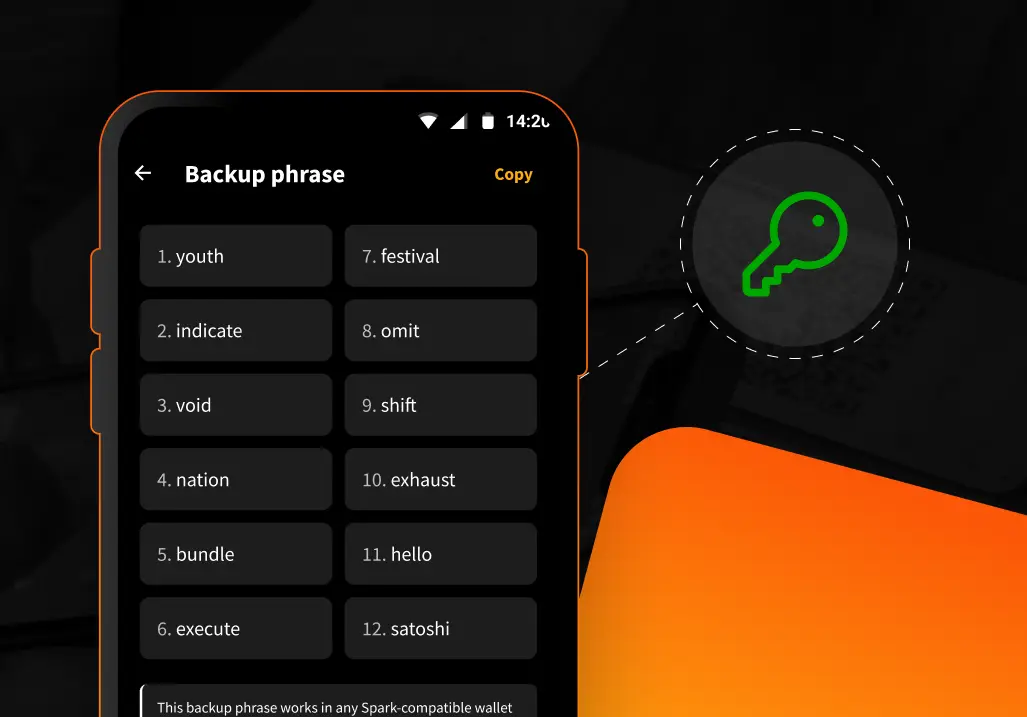
When you create or use a non-custodial account, we give you a secret recovery phrase. Twelve words. Write them down, guard them with your life. That phrase is the master key to your Bitcoin, and only you have it.
Here is what changes in practice:
The same smooth experience. Your customers will still scan the same QR code, send to the same Lightning address, and see the same instant confirmation. You will still be able to switch between accounts. Receive, send and transfer as usual. What changes is under the hood.
The same lightning address. Keep the same username@blink.sv Lightning address you already use. Nothing changes for the people paying you.
Hold a non-custodial Dollar Balance. Just like in the custodial accounts, we provide a Dollar Balance, where you can keep USD alongside your Bitcoin. The Dollar Balance is non-custodial just like the rest of your wallet. Transfer between your Bitcoin Balance and Dollar Balance in a tap, whenever you want.
We can’t touch your funds. Because you hold your keys, no single operator — and no group of operators — can access your funds without your involvement. This is what non-custodial means: control enforced by cryptography, not by promises.
You can exit to the Bitcoin main chain. Under the hood, your funds live on the Spark protocol. If Spark’s operators ever go sideways, the protocol is designed so that you can move your Bitcoin back to Layer 1 using pre-signed transactions. This exit capability is not yet exposed in the current version of the Blink app, but is supported at the protocol level.
The wallet is just an interface. With your recovery phrase you can access your funds in other Spark compatible wallets. This means that if we would disappear tomorrow, you could just open up another Spark compatible wallet and keep transacting as if nothing had happened.
True ownership means true responsibility — but we've made it easier. If you lose your recovery phrase, we cannot help you. There is no "forgot password" button. There is no customer support ticket that will get your funds back. That said, we know that not everyone is going to engrave twelve words into a steel plate and store it in a fireproof safe. So, we've built plug-and-play backup options: you can save your recovery phrase to Google Drive or iCloud, or let your password manager auto-save it. Are there better way to do backups? Yes. But a cloud backup you actually do is infinitely better than a steel plate backup you never get around to doing.
Not everything made it to day one. Some features you know from the custodial wallet are still on their way. We’d rather get non-custodial control into your hands now and bring the rest along as the platform matures.
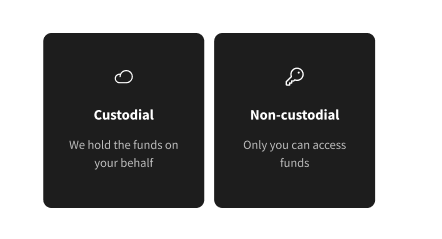
For most of the world, going non-custodial starts as a new account option. Your current custodial Blink Wallet keeps working exactly as it does today. If you already have a custodial account, you can keep it.
A migration path — letting you move your existing funds into a non-custodial account — is planned shortly after launch. When you want, you will be able to migrate. But it will not be required for most users.
In some countries, because of regulatory developments, we plan to ask users to migrate from custodial to non-custodial accounts in the near future. But first we want to make sure the non-custodial experience is solid before we ask anyone to make the switch.
To get started, choose the Non-custodial option when setting up a new Blink Wallet, or go to Settings → Switch Account → Add New Account and select non-custodial from there.
That’s everything you need to get started. What follows is the full story of how we got here — and why we chose the path we did.
The Full Story
The story of Blink is inseparable from the story of Bitcoin Beach. In 2019, Mike Peterson, an American living in the small beach community of El Zonte, El Salvador, had the idea to create a circular Bitcoin economy in a community where most people were locked out of the traditional banking system. He was, by his own admission, "too naive" to know that many were saying that Bitcoin was not yet ready for everyday commerce. That naivety was a superpower. He just saw people excluded from the financial system and thought: “This is what Bitcoin was made for!”
The team started with on-chain transactions. At first, fees were a few cents and everybody in the village knew each other, so waiting for confirmations wasn't a deal-breaker. But then the Bitcoin price started rising, and with it the transaction fees. Small merchants taking lots of little payments were suddenly paying $10 in fees just to consolidate $50 when cashing out. That wasn't going to work.
Everyone said Lightning was "18 months out." Mike tried Lightning anyway with Wallet of Satoshi. Payments went through 99% of the time. So, they pushed everything onto Lightning. Sometimes not knowing the rules is the best way to break them and make progress happen.
But there was a bigger problem. The pupusa vendor wiping flour off her hands to fumble with a phone. The store that couldn't accept Bitcoin when the owner wasn't there. A 70-year-old woman running a shop with intermittent internet who needed something simpler than what any developer sitting in a nice office with high-speed fiber connection would ever dream up. If the new money was harder than cash, nobody was going to use it.
That's when Galoy — a Bitcoin infrastructure company — called Mike out of the blue and offered to build a wallet specifically for the community's needs. Crucially, they moved to El Zonte to gain a better understanding by observing first hand. They watched real unbanked people do electronic commerce for the first time in their lives. They saw where people got stuck, and they fixed it. Static QR codes so merchants didn't have to generate a new invoice for every sale. Usernames so people could send Bitcoin like a text message. A map so customers could find merchants who accept Bitcoin. Every one of these features was born from watching real people in a real community try to use Bitcoin in everyday life.
But none of it would have worked without trust. Before Bitcoin ever entered the picture, Mike had spent years doing youth outreach in El Zonte — running Hope House, a community center offering English classes, computer training, and youth programs to give kids an alternative to emigration and gangs. When you've been showing up for a community that long, people are willing to listen, because they trust in your good intentions. Mike and his team shared a different way to handle money and the community engaged.
That wallet — built for the pupusa vendors and surf instructors and corner stores of El Zonte — was called Bitcoin Beach Wallet. It eventually spun off from Galoy as its own company and was renamed Blink. And the design philosophy born from those dusty streets, that relentless focus on simplicity and reliability for people who don't have the luxury of complexity, is what we still build on today. The Bitcoin Beach project inspired hundreds of circular Bitcoin economy projects around the world, from Costa Rica to Brazil, South Africa, Nigeria, Kenya and beyond — and Blink is proud to be the wallet of choice for many of them.
Since then, Blink has grown far beyond circular economies into remittances, online commerce, community fundraising, creator tipping, developer tooling and everyday Bitcoin use by people and communities all over the world.
You can learn more about the early days of Bitcoin Beach and Blink in this deep dive podcast with Mike Peterson.
We've always known that regulations would accelerate for custodial Bitcoin services. It was never a question of if, just when.
In 2025, the "when" arrived from every direction at once. Google told custodial crypto apps: get a local license in 15 jurisdictions or get removed from the Play Store. Europe's MiCA regulation went live with a definition of custody so broad that holding a key share might qualify. South Africa, Kenya, Hong Kong, the UAE and many more rolled out their own new regulations.
Now, we could have gone jurisdiction by jurisdiction, collecting licenses, hiring compliance teams, filling out forms. Some companies did. But that's just not us. We didn't start this company to become experts in financial regulations worldwide. We started it because a pupusa vendor in El Zonte needed a better way to get paid and manage their money.
So we asked ourselves: what if the answer isn't more licenses, but less custody? What if instead of asking permission from every regulator on the planet, we just give users their own keys — so the custody-related regulatory obligations that apply to us are fundamentally reduced? That was always the destination. The regulators just gave us a reason to get there faster.
We mobilized the team and spent months evaluating every serious option. We talked to protocol developers, legal teams, CEOs, CTOs, and Bitcoin engineers. We had our lawyers analyze the regulatory implications of each solution under European, US, and various other jurisdictions. We brought our board members, our infrastructure team, and our developers into the conversation.
A sovereign Lightning node on every phone — the approach pioneered by ACINQ with Phoenix Wallet — was the most appealing from a pure sovereignty standpoint. Every user runs their own Lightning node, holds their own keys, and there's essentially zero custody risk. Our lawyers rated it the gold standard for non-custodial classification. We even spoke to a company that was far advanced in building a competing implementation and was willing to share it with us if we wanted to co-build. But the reality was that building this kind of solution from scratch for our user base — with the reliability and simplicity they depend on — was simply too far out. And even where these solutions exist today, they tend to be mature-user products: great for someone who already understands Lightning channels and liquidity management, but not quite the simplicity that a first-time Bitcoin user in the Bitcoin Ekasi community project in Mossel Bay needs. The right vision, but the wrong timeline and the wrong audience. We needed to ship something now, not in a year — and it had to work for beginners, not just enthusiasts.
Sub-licensing under a regulated partner was the second door we opened. On paper, it works: partner with a licensed entity, operate under their licenses, keep serving users. But when we dug in, the reality was suffocating. The European travel rule requires both sides of every transaction to be identified — no threshold. That means a chapati street food vendor in the Bitcoin Kampala community in Uganda would need to identify every customer who pays with Lightning for their next rollix. It means your anonymous donation button on your website stops working. It means participating in a surveillance regime that is fundamentally opposed to everything Bitcoin stands for. We walked away.
Liquid, the Blockstream sidechain, was tempting. It's battle-tested, has been in production for years, and features confidential transactions that hide payment amounts. One of our board members designed an elegant solution using a 2-of-2 multisig that would give users instant payments while preserving self-custody. But Liquid has a hard floor: you can't send less than about 41 satoshis, and fees eat small payments alive. For the communities we serve such as the bitcoin community Afribit Kibera in the slums of Nairobi — where small daily purchases are the lifeblood of the Bitcoin economy — that was a deal-breaker. Also, Liquid is not a true Layer 2. Your Bitcoin becomes L-BTC, a different asset, secured by a federation. You have to trust the federation. That's a meaningful trade-off.
Ark isn’t a single product — it’s a protocol specification with several independent implementations, such as Second’s Bark and Ark Labs’ Arkade, each making different choices on openness, swappers, and trust. Ark excited us with its ambition. True unilateral exit. Flexible scripting. An open-source protocol. But the more we dug in, the more we found friction. User funds live in VTXOs that expire after about four weeks. If a user doesn't come online to renew them before expiry, the operator can sweep those funds — and while the user may still be able to recover them, they lose the ability to unilaterally enforce their ownership on-chain. That's a meaningful loss of sovereignty. And when we looked at our own data, we saw that a meaningful percentage of our users don't open the app every month. We couldn't build on a system where inactive or store of value oriented users gradually lose control of their funds. Ark Labs has since introduced delegation, which lets users authorize a third party to renew on their behalf, but at the time of our evaluation that solution didn't exist yet. The operator also faces substantial liquidity requirements — needing to front significant capital to fund every round — which creates scaling challenges. And critically, at the time of our evaluation, Ark was simply too far from production readiness for us to bet our users' experience on it.
Spark, built by Lightspark, is a federated state chain protocol where operators hold key shares — but no single operator, and no group of operators, can touch your funds without your involvement. Rather than routing trust through a single operator, Spark spreads it across multiple independent operators, with only one needing to be honest at the time of your transaction. You can receive payments while completely offline. There are no minimum amounts — you can send a single satoshi. There are no fund expiry deadlines. And the protocol provides an exit path back to the Bitcoin main chain if everything goes wrong.
Spark’s core is open source — the client, the Spark Operators, and the Spark Entity are all open. But two key things sit outside that. The Lightning swapper (the Spark Service Provider, or SSP) is closed-source and operated by Lightspark, so Lightning interoperability currently depends on them. And while you can run your own Spark and be your own validator, joining Lightspark’s production federation as an operator is permissioned — the Spark Entity curates its operator set to keep the network reliable. These are real tensions for a company rooted in the open-source Bitcoin movement, and we discussed them extensively.
When we first evaluated Spark in late 2025, transaction data was publicly visible on the network indexer — a serious privacy concern. We were assured by Roy Sheinfeld, the CEO and Founder of Breez, that he was working with the Spark team on a privacy roadmap with various privacy fixes coming very soon. Since then, Lightspark has delivered on the privacy promises we received: transactions are no longer publicly indexable, and single-use Bolt11 invoices that do not encode the Spark identity public key prevent a single payment request from exposing your history. Further improvements including confidential transactions are still in development.
Culturally, Lightspark is a Silicon Valley company backed by $175 million in venture capital. That's a very different world from the one we come from.
When we put every solution side by side and measured them against what our users actually need — single-sat payments for the Global South, offline receive for people with unreliable internet, no fund expiry for people who don't open an app every week, a credible legal argument for non-custodial classification, and something that was actually production-ready and not a whitepaper promise — Spark was the only one that checked every box. Our evaluating team of over ten people, after months of research, voted unanimously for Spark. Not because we fell in love with it, but because it was the only solution that could serve our users without compromise.
In daily life, what all those technical trade-offs come down to is this: a merchant can take a payment as small as a single sat, receive it even if her phone drops signal, and come back to her balance weeks later without anything having expired or disappeared — and Blink never held her keys the entire time.
An additional benefit was that our partner Breez had already spent months integrating Spark into their SDK, giving us a battle-tested, open-source integration path to build on.
While the team was neck-deep in protocol comparisons, we had a law firm doing the same exercise from a completely different angle. Doktór Jerszyński Pietras (DJP), a European financial services law firm, independently analyzed all the four candidate technologies — and advised us separately on the sub-licensing route. Their job was simple: assess the risk that a European regulator could classify each of these solutions as custody.
Turns out the lawyers and the engineers mostly agreed. The sovereign Lightning node came out with the lowest custody risk — essentially negligible. But as we explained above, it wasn't production-ready for our users. Sub-licensing was legally clear but philosophically bankrupt. Liquid and Ark both had question marks.
Spark scored well. DJP's conclusion:
The risk of Spark wallet providers being classified as CASPs for custody services is low, as users retain full control of their private keys at all times — operator keys cannot control user funds or act on their behalf.
— Gracjan Pietras, Attorney and Partner at DJP
The risk of being classified as providing transfer services was also assessed as low.
None of this has been battle-tested with regulators yet. Nothing in this space has. But we didn't want to make a decision based on gut feeling and hope. We wanted independent legal analysis covering every option — and now we have it.
The Choice
And that "for now" matters. When we made this decision in late 2025, Spark best met our users’ needs and was production-ready enough to ship. But this space is moving fast, and the comparison between these protocols is genuinely nuanced. We’re not wedded to any one design: openness and permissionlessness matter deeply to us, and as the ecosystem matures we’ll keep evaluating every option openly — Spark included — and adopt whatever best serves our users.
Blink started as the everyday Bitcoin wallet for a small beach town where people needed money that worked simply, reliably, and without permission. That hasn’t changed. The pupusa vendor in El Zonte shouldn’t have to choose between ease of use and real ownership. With non-custodial accounts, she keeps the Blink experience her customers already know — while the keys to her money belong to her.
That’s the next step for Blink: the everyday Bitcoin wallet, now with non-custodial control built for real life.
Check out Spark for the protocol details.
Spark is trust-minimized, not trustless. Operators hold key shares and participate in signing transactions, but no single operator — and no group of operators acting alone — can take your funds. The trust model requires that at least one operator is honest during the time of your transaction. The protocol is designed to provide an exit path to the Bitcoin main chain. It’s not the same as holding Bitcoin in cold storage on Layer 1. But for the payment use case — instant, low-cost, mobile, everyday transactions — it’s as close to true non-custodial control as anything that exists today.
Spark is a Layer 2 protocol for Bitcoin built by Lightspark. It lets you make instant, low-cost payments without giving up control of your keys. We chose it after months of evaluating every serious alternative because it was the only solution that met all our requirements at the time: no minimum payment amounts (critical for the communities we serve), true offline receive (critical for users with unreliable internet), no fund expiry (critical for users who don't open the app every day), and independent legal analysis assessed custody-service classification risk as low. It's not perfect — parts of it are closed-source and we wish it were more open. But it was production-ready when we needed it. Other protocols like Ark are catching up fast, and we keep monitoring the developments closely and will adopt whatever technology best serves our users.
They serve the same purpose — letting you hold a dollar-denominated balance alongside your Bitcoin — but they work differently under the hood. The custodial Dollar Balance uses Stablesats, where Blink manages the dollar peg on your behalf using derivatives. The non-custodial Dollar Balance uses USDB, a stablecoin on the Spark protocol, which you hold with your own keys just like your Bitcoin. From your perspective the experience is the same: a dollar balance you can convert to and from Bitcoin in a tap. The difference is ownership — with the non-custodial Dollar Balance, you hold the keys.
In supported regions, yes. You can hold a non-custodial Dollar Balance and transfer between your Dollar Balance and Bitcoin Balance in a tap.
Not yet. The non-custodial wallet is new, so some features from the custodial experience may arrive later as the non-custodial account matures.
You will be able to keep your Lightning address (username@blink.sv) when you migrate. The people who pay you won't notice any difference.
Because only you hold the keys, we can’t recover a lost phrase or reset access. This is the fundamental trade-off of non-custodial ownership: you get control of your keys, and full responsibility. That’s why we offer multiple backup options — Google Drive, iCloud, and password manager auto-save — alongside the traditional pen-and-paper method. Use whichever one you’ll actually keep safe.
Not right now. Existing wallets keep working as before. In certain jurisdictions where regulations have made custodial services impractical, we will offer a migration path shortly after launch and will give you clear guidance when it's your turn to transition.
Start receiving and sending bitcoin now

.webp)