Every M-Pesa number in Kenya now works as a Bitcoin Lightning Address. Tando said 40 million Kenyans can receive bitcoin that arrives as KES in their M-Pesa — and Sabina tested it at a supermarket, a tailor, a water vendor, and a Maasai guide in Amboseli. Meanwhile, Lightning volume hit $1 billion per month, LDK released a production-grade server node, Bolivia's merchant count rose from 33 to 134 in twelve months, and South Africa's draft capital-flow regulations entered their final week of public comment.
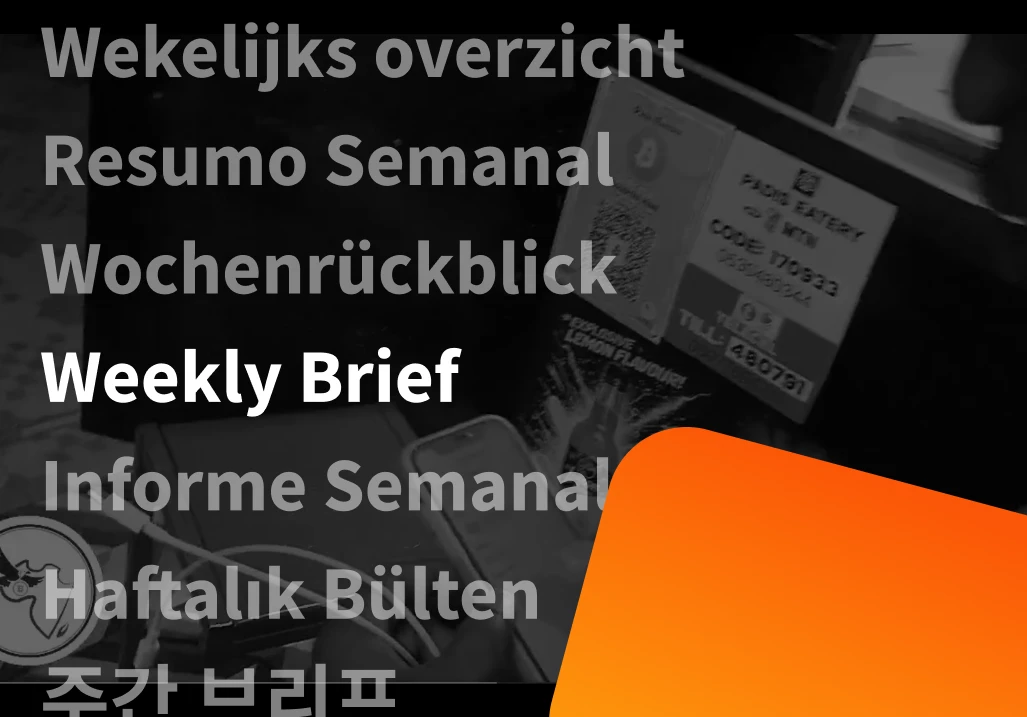
Tando — 40 million M-Pesa numbers are now Lightning Addresses: Every M-Pesa phone number in Kenya can receive bitcoin sent from any Lightning wallet to phone@bitcoin.co.ke. BTC is converted instantly to KES in the recipient's M-Pesa. Sabina tested it in the field: supermarket items, a tailor visit, bottled water, a snack, and Maasai guides in Amboseli — all at 30–50 KSh per transaction, saving 30 shillings in fees each time. Tourists can pay without cash, a local SIM, or a bank card.
Spotlight: Lightning Hits $1 Billion per Month — and Now Anyone Can Run the Stack
At the BitGo High Roller Summit during Bitcoin 2026, a panelist cited River data showing Lightning is now processing approximately $1 billion per month in volume — 3–5 orders of magnitude above activity in 2020. Still small relative to Visa and Mastercard, but the trajectory is vertical.
In the same week, LDK (@lightningdevkit) released a production-grade Lightning node for servers — packaging the same components it said power payment services at Cash App, Square, Money Dev Kit, Lightspark, Lexe, and Alby into a daemon anyone can run. The gap between the infrastructure that powers billion-dollar flows and what a solo developer can deploy just collapsed.
1) Merchant & Enterprise Adoption
Merchant growth was most visible this week in Bolivia's year-over-year count data, South African travel checkout, and a Zambian merchant cluster that keeps adding acceptance points.
- Bolivia — 33 merchants a year ago, 134 today: Bitcoin Research (@bitcoinr3) said Bolivia's BTC Map footprint rose from no more than 33 places in May 2025 to 134 in May 2026 — a fourfold increase in twelve months. Growth is national: La Paz leads, but Cochabamba, Santa Cruz, Tarija, Beni, and El Alto all have listed merchants. New additions include a BitBase branch, a barber shop, and Las Mañaneras El Alto through the AyniBitcoinMarket program.
- South Africa — TravelwingsZA adds Bitcoin for flight bookings: TravelwingsZA (@TravelwingsZA) now accepts Bitcoin at checkout for flights via PeachPayments, with Lightning support. The booking flow names Bybit, Binance, Luno, and VALR among supported wallets. MoneyBadger (@MoneyBadgerPay) promoted the integration. Flight bookings are one of the highest-value recurring categories Bitcoin payments have entered in South Africa.
- Zambia — three-merchant Lightning cluster near Victoria Falls: Bitcoin Victoria Falls (@BitcoinVicFalls) highlighted three merchants — phillardshop, it_enterprise, and mundayamirestaurant — all using Blink and BTC Map. Locals are learning to use Bitcoin as everyday money. Some merchants "actually love Bitcoin."
- Pan African Bitcoin Tour — $5,602 bookable in Bitcoin: A 12-night, multi-country tour visiting Bitcoin circular economies across Africa, priced at $5,602, is bookable in Bitcoin through Airbtc (@Airbtconline). Payments close July 26. This is the highest single-ticket Bitcoin payment product the brief has documented.
2) Payment Infrastructure
Beyond the Tando and LDK stories covered above, infrastructure progress centered on local-currency settlement, cross-border rails, and merchant platform integration.
- Tando adds KES invoicing and receipt links: Tando (@tando_me) said wallets supporting LUD-09 can now show a clickable M-Pesa receipt link after payment. Pre-spec LUD-21 support lets senders request a Lightning invoice for a specific KES amount and receive the corresponding sats invoice. This closes the UX gap between "pay in bitcoin" and "price in local currency" for everyday Kenyan transactions.
- Mavapay — Lightning as cross-border rail from Lagos: Mavapay (@mavapay), a Lagos-based Bitcoin Lightning payment platform, is advancing Lightning as a cross-border settlement solution. CEO Theophilus Isah said Lightning "settles payments in less than a second" using invoice-based flows rather than traditional address-and-transaction patterns.
- Lightning Enable targets Shopify merchants: Lightning Enable (@lightningenable) said it is building infrastructure for Shopify stores to accept Lightning payments from both humans and AI agents, and is already working with live Shopify merchants.
- Tando remittance rail for the diaspora: Kenya receives $5 billion per year from its diaspora. Tando's remittance product lets senders deliver KES to any M-Pesa account from any Lightning wallet in seconds. The claim: 99% reaches the recipient, compared to 5–10% fees at Western Union.
3) Circular Economy & Ground-Level Proofs
The strongest ground-level evidence this week came from Kenya, El Salvador, Mozambique, and a community-level regulatory response in South Africa that showed what happens when adoption meets policy.
- Kenya — high school student buys pads with saved sats: A student who earned sats through a Bitcoin education program used her savings to buy sanitary pads. Bitcoin Chama (@Bitcoinchama) described it as "everyday money." This is a repeat-earned, essential-need purchase — not a demo transaction.
- Mozambique — Olympia Gym accepts Lightning 24/7 in Maputo: Bitcoin Famba (@BitcoinFamba) listed Olympia Gym on BTC Map with a Blink Lightning address, open 24/7 including holidays. A fitness membership is a recurring-spend category — higher lifetime value than a one-off food purchase.
- El Salvador — routine purchases in Berlín: Bitcoin Berlín (@BitcoinBerlinSV) documented charcoal and nachos at Super Rosario, and shoes at Calzado Stevens. Both described as "just part of the routine" and "like any other day." Three years in, Berlín treats Bitcoin as normal.
- South Africa — communities mobilize against draft capital-flow rules: With the public comment deadline on May 18, Bitcoin Ekasi (@BitcoinEkasi) went house-to-house mobilizing against the draft regulations. Bitcoin Witsand (@BitcoinWitsand) argued the rules would hurt users "from children going to the spaza shop to families trying to protect savings." The grassroots response to a regulatory threat is itself an adoption signal — these communities are defending infrastructure they depend on.
- Cross-market grassroots spend: Bolivia's RINCON_COCHALO served chicharrón for Bitcoin with tips in sats. In Peru, Motiv Peru (@MotivPeru) highlighted El Elio Surf School in Huanchaco joining the "Orange Wave." BTC Paraguay (@BTCParaguay) scheduled a Lightning Market for May 16. Uganda's Orphans of Uganda began onboarding local vendors. Nigeria's Tosine Gas continued accepting sats for cooking-gas refills. The Blink + BTC Map stack keeps appearing — Haven food court, Ashagardens, Embo Restaurant, Viwa accessories, Mucambe, Grandsmatt, Richland General Shop.
Forty million M-Pesa numbers just became Lightning endpoints. Lightning is moving a billion dollars a month. Bolivia quadrupled its merchant count in a year. And in South Africa, the people who use Bitcoin every day are going door to door to defend it. The rails are scaling. The communities are not waiting. See you next week.