


BLOG |
Adoption stories
be-BOP, a free and open-source sales toolbox built in Switzerland, now accepts Blink as a Lightning payment option.


be-BOP, a free and open-source sales toolbox built in Switzerland, now accepts Blink as a Lightning payment option. There was no partnership and no roadmap negotiation behind it. Because be-BOP is open source, Kemal Yaşar, who leads Special Projects at Blink, built the integration himself and opened a pull request under his personal GitHub handle, which be-BOP merged.
Instead of just announcing the feature, we sat down with be-BOP's co-founders, Lionel Jeannerat and Christophe Gérard, to hear how it started, who's running it, and what it means to build a tool anyone can add to.
be-BOP is a free and open-source monetization platform that merchants and communities run themselves. It brings e-commerce, point of sale, subscriptions, crowdfunding, ticketing, and donations into one tool, and it takes no cut of your sales. You self-host it or use their cloud, and keep control of your data, your storefront, and your funds. It's published under the GNU AGPL v3, and the repository states the terms plainly: no vendor lock-in, no paywall, no subscription, no sales commission, ever.
Payments are the merchant's choice: cash, cards, or Bitcoin, all in one system. That was the founding idea. As Christophe put it, when you accept Bitcoin you expect the same resilience, censorship resistance, and privacy that Bitcoin itself offers, and stapling a Bitcoin processor onto a platform like Shopify, which tracks and monetizes user data, breaks that expectation. be-BOP was built to keep that whole system private end to end.
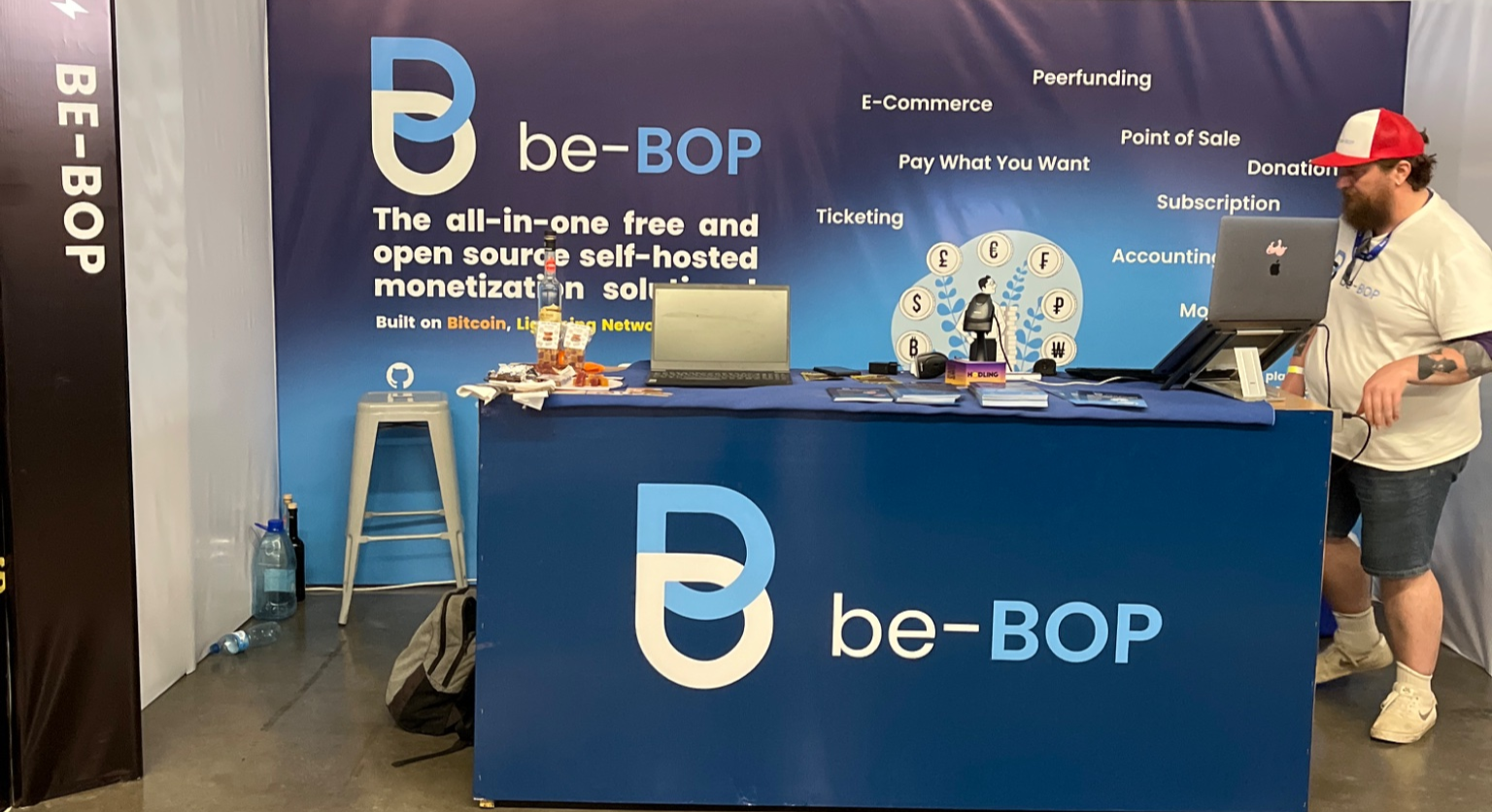
be-BOP started about three and a half years ago. Lionel runs a book publishing company, and selling books, ebooks, running crowdfunders, and taking payments at festivals meant stitching together a pile of tools, none of which respected the privacy he and Christophe cared about. They had already tried bolting a Lightning module onto PrestaShop. It wasn't enough.
Lionel had the idea and secured the funding; Christophe, who had previously worked in quality assurance for an online bank payment processor, took on product management. That earlier job shaped be-BOP's ethics. In his words, he "saw stuff about user data exploitation" that was legal but wrong, and came away convinced that every Bitcoin and payment project should be open source so anyone can audit what it really does.
In Lionel's original funding proposal, the project was BOP, for Boutique Online Peer-to-Peer ("boutique" is French for shop). The community suggested adding "be," which also nods to bebop, the jazz style Christophe favors. The capital letters in be-BOP still carry the original meaning: it's your shop, peer to peer.
be-BOP was built with public money from the Swiss Canton of Neuchâtel, on a condition Lionel proposed himself: if the state funds it, the code should be public. That runs against almost everything Bitcoiners expect from a government.
Neuchâtel is a small canton, around 180,000 people, historically built on watchmaking and precision industry rather than finance. Since roughly 2015, when Bitcoin brokers struggled to get bank accounts elsewhere, Neuchâtel's government asked its cantonal bank to serve them, and an ecosystem of technically minded builders grew up around that openness. A cooperative called B2Bitcoin now helps structure it.
Lionel could have kept the code closed. He didn't:
"I could have chosen to close the source. But I said, it's public money, the code should be public as well. They agreed. They didn't always know exactly what that means, but they understood it was better."
The support was a grant, not an equity investment or a loan. In Lionel's words, the goal was to "crystallize knowledge" into a tool and give the canton a project to point to. He had a track record with the state from his publishing work, so they trusted him to deliver, and he says be-BOP delivered more than it promised.
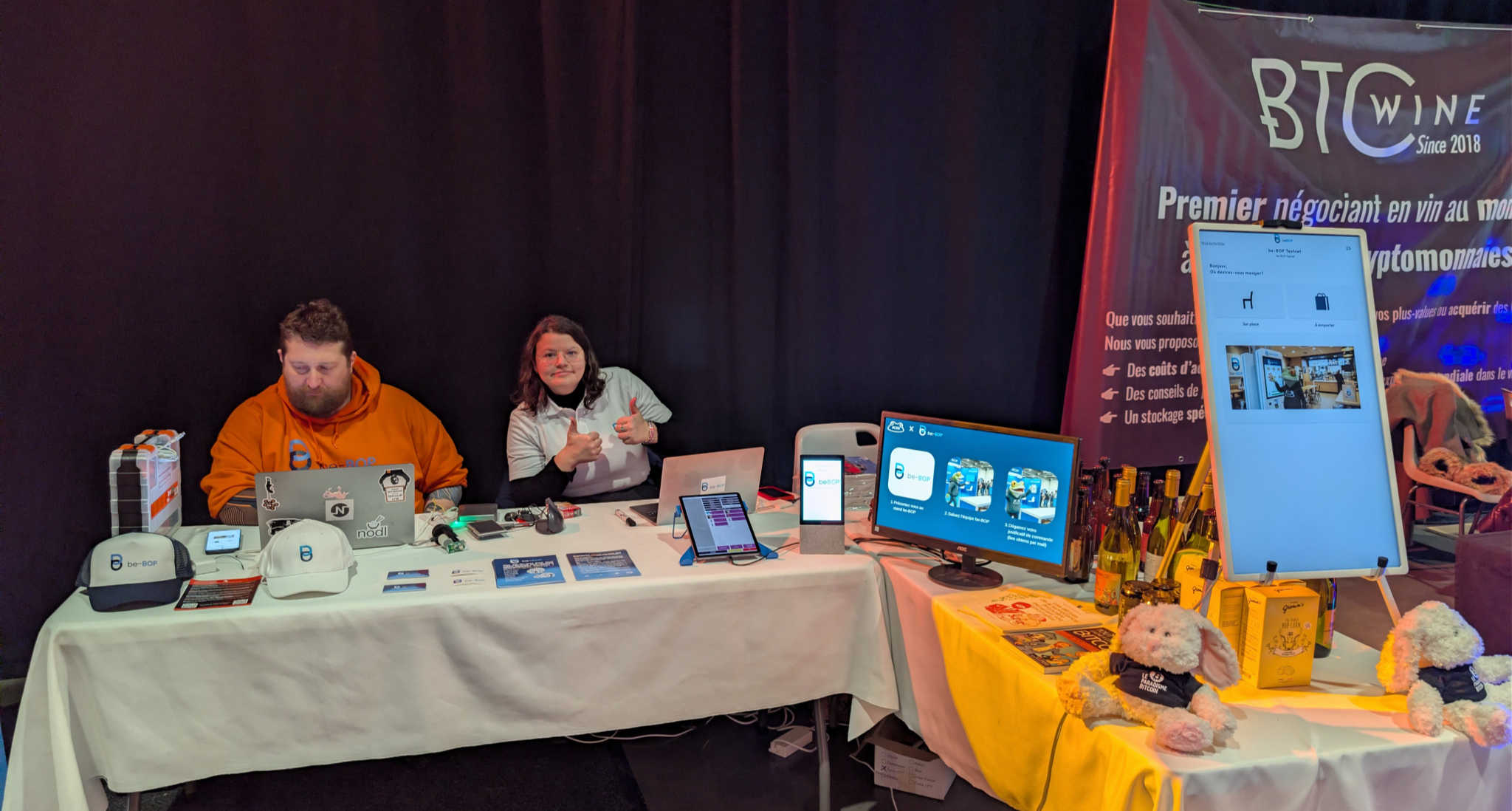
be-BOP runs shops, events and associations today, starting with its founders'.
Lionel's publishing house, PVH Éditions, is one of the oldest be-BOP instances, selling books and ebooks online and taking payments in person at book festivals. Many of his readers are free-software people who didn't want to hand over a name to buy an ebook, and he says ebook sales rose after he launched a private checkout. Two other independent publishers run on it: the Swiss fantasy author Sara Schneider, and Éditions Petites singularités, a militant press that also takes GNU Taler.
Retail and hospitality look much the same. BitcoinStore, run by the French YouTuber and clothing maker Mill3sim3, sells Bitcoin goods and peerfunds his own projects on his own instance rather than through a crowdfunding platform that takes a cut. LAB 312 sells security coaching and hardware. Montarouet, a holiday rental in the French countryside, takes bookings in fiat and Bitcoin. Closer to home for the team, the bar at Coffice, their co-working space in Neuchâtel, runs on be-BOP too: coffee, sandwiches, beer, even absinthe, payable in Lightning, which gives them feedback from staff serving real customers all day.
The third group is events and memberships. Le Paradigme Bitcoin, a French-speaking Swiss conference now six years old, handles its ticketing on be-BOP, as does the upcoming PROOF Conference in Vilnius. Le Cercle du Coin, the oldest French-speaking Bitcoin association, manages its subscriptions with it, and the Costa Rica Freedom Forum used it for a past edition. be-BOP was also the voting software for the Africa Social Impact Award at the Africa Bitcoin Conference 2024, where attendees voted for eight shortlisted projects with sats. Christophe reckons that against a platform taking a five percent cut, it saved the projects around $400. In Africa, he said, you can do a lot with that.
And, inevitably, be-bop.io runs on be-BOP.
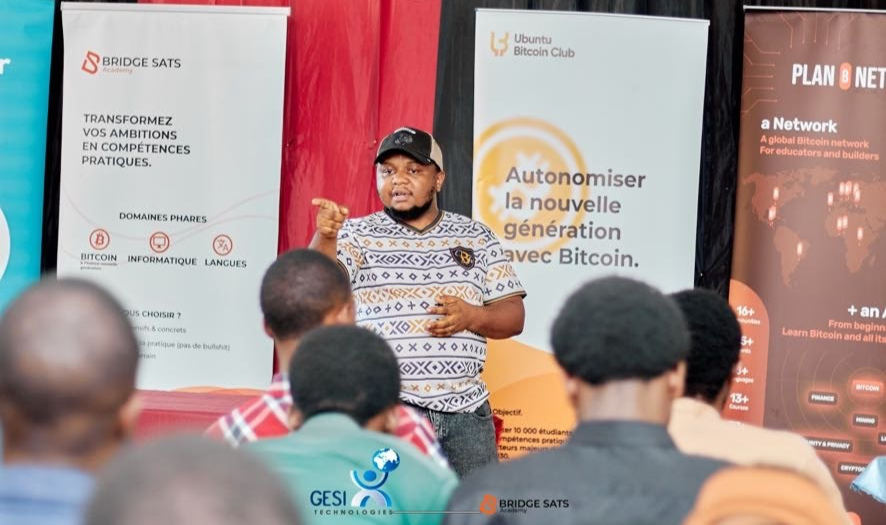
One of be-BOP's most committed users is a long way from Neuchâtel. Gloire Kambale Wanzavalere runs Bridge Sats and Kiveclair from Goma, in the east of the Democratic Republic of the Congo, and co-founded the Africa Bitcoin Conference. By his own public account, he has used be-BOP since its early days.
Goma has been cut off from the banking system for over a year since rebels seized the city, and even before that, only about a quarter of the country's working population had a bank account. Payment tools that don't need a bank aren't a philosophical preference there.
Gloire set out his reasoning for be-BOP publicly back in 2024, when he listed it among the partners behind his plan to grow Bitcoin use across the Congo: an infrastructure combining Bitcoin and Nostr, which he wanted to use to build sovereign marketplaces, and which he called the right tool for driving Bitcoin adoption among local businesses.
He has since built on it steadily. Around fifty projects now run on be-BOP through his team, including sites for local NGOs raising funds without intermediaries. Kiveclair's own site runs on it. In 2024 he launched Wazibooks with Lionel's PVH Éditions and Konsensus, selling locally printed books at two to three times less than imported ones. He also set up a be-BOP donation page funding meetups, a reading space, shelter for a refugee, and Bitcoin training. He summed it up to Fedi's Frank Corva:
"It's one of my favorite projects for Bitcoin adoption. It's open-source, without any plugins, and it's an infrastructure that prepares Africa for Bitcoin adoption. Our clients use be-BOP for their site today and can activate Bitcoin tomorrow without much of a hassle."
A merchant gets a working site now and turns Bitcoin on when they're ready, which is a far lower bar than asking someone to adopt Bitcoin and rebuild their shop at the same time.
be-BOP had wanted a Blink integration for about a year and a half. They knew it was worth doing. But money was tight and priorities were stacked, so it kept waiting.
So instead of waiting, Kemal built it and opened an external pull request to be-BOP's repo. They reviewed it like they would from anyone, and merged it.
For Christophe, that moment was the whole point of building in the open:
"Then from one day to the next, someone shows up with a good, clean integration of Blink. This is what I wanted to live. Anyone in the world can bring their own brick to the project, and it's there for everyone."
be-BOP said as much when they announced the merge:
"Blink rejoint les processeurs Lightning supportés par be-BOP. C'est une PR externe de pretyflaco, pas quelque chose qu'on a codé en interne. C'est là qu'on voit l'intérêt du Libre. On préfère ajouter des options plutôt qu'enfermer les marchands dans un seul wallet."
("Blink joins the Lightning processors supported by be-BOP. This is an external PR from pretyflaco, not something we coded internally. This is where we see the value of Open Source. We prefer to add options rather than lock merchants into a single wallet.") — be-BOP, announced on X
Blink replied in the same spirit:
"Génial ! Merci pour l'intégration et le soutien. Vive l'open source et la liberté de choix pour les marchands !"
("Great! Thanks for the integration and support. Long live open source and freedom of choice for merchants!") — Blink Wallet, replying on X
Nobody needed permission. Nobody had to wait for a company to prioritize it. Kemal saw the two would work better together and built it in the open. be-BOP already took Lightning through a merchant's own node, nodelessly with phoenixd, or via BTCPay Server and Swiss Bitcoin Pay. Blink now sits alongside them in be-BOP's own README, and every be-BOP merchant gets it.
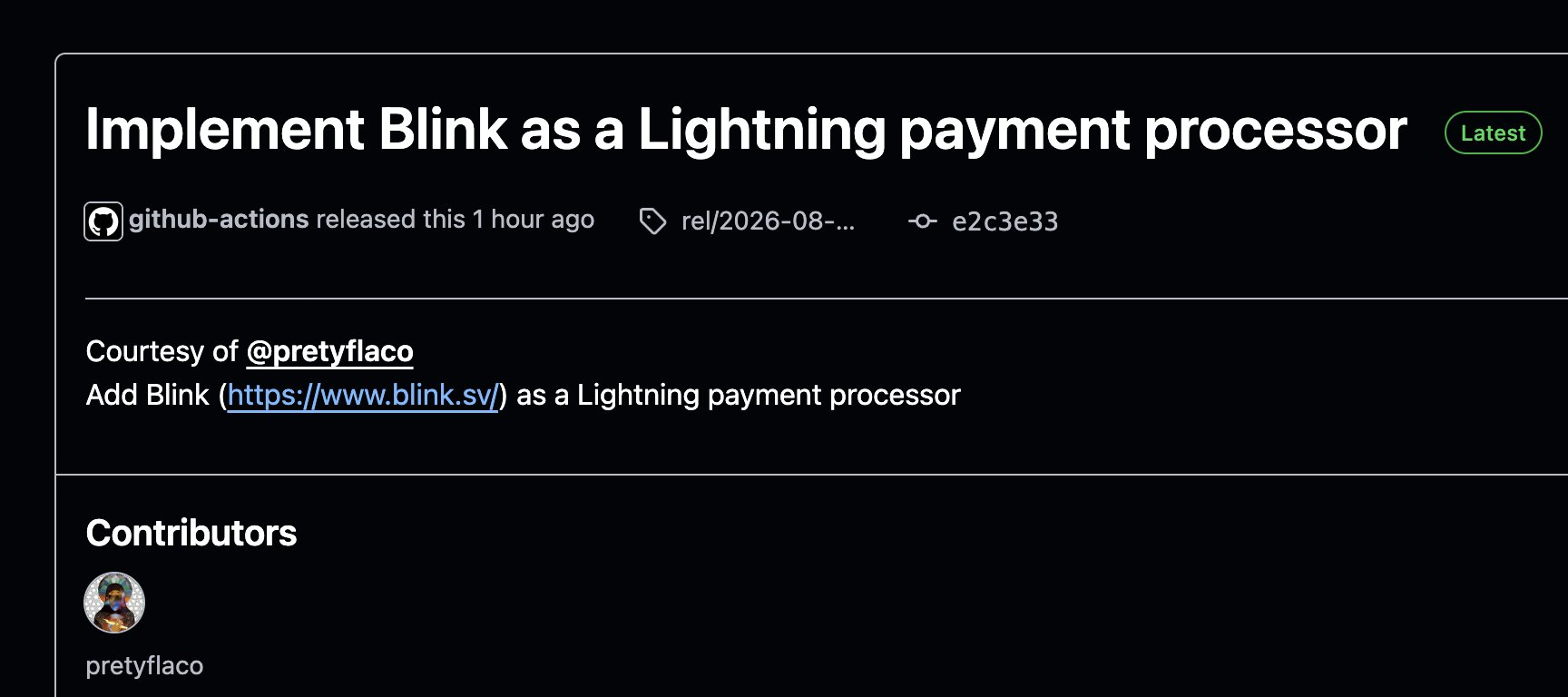
The contribution, PR #2693, adds Blink as a Lightning payment processor. It's receive-only: a be-BOP store can accept Lightning payments straight into a Blink account. be-BOP detects which kind of Blink connection a merchant is using from the credentials they enter, whether that's a custodial account with an API key, a custodial account by Lightning address, or a non-custodial (Spark) account. The result is the same on any of them: a customer pays a Lightning invoice, and the sats land in the merchant's Blink account.
No node to run, no BTCPay instance to host, and no custodian if you use a non-custodial Blink account.
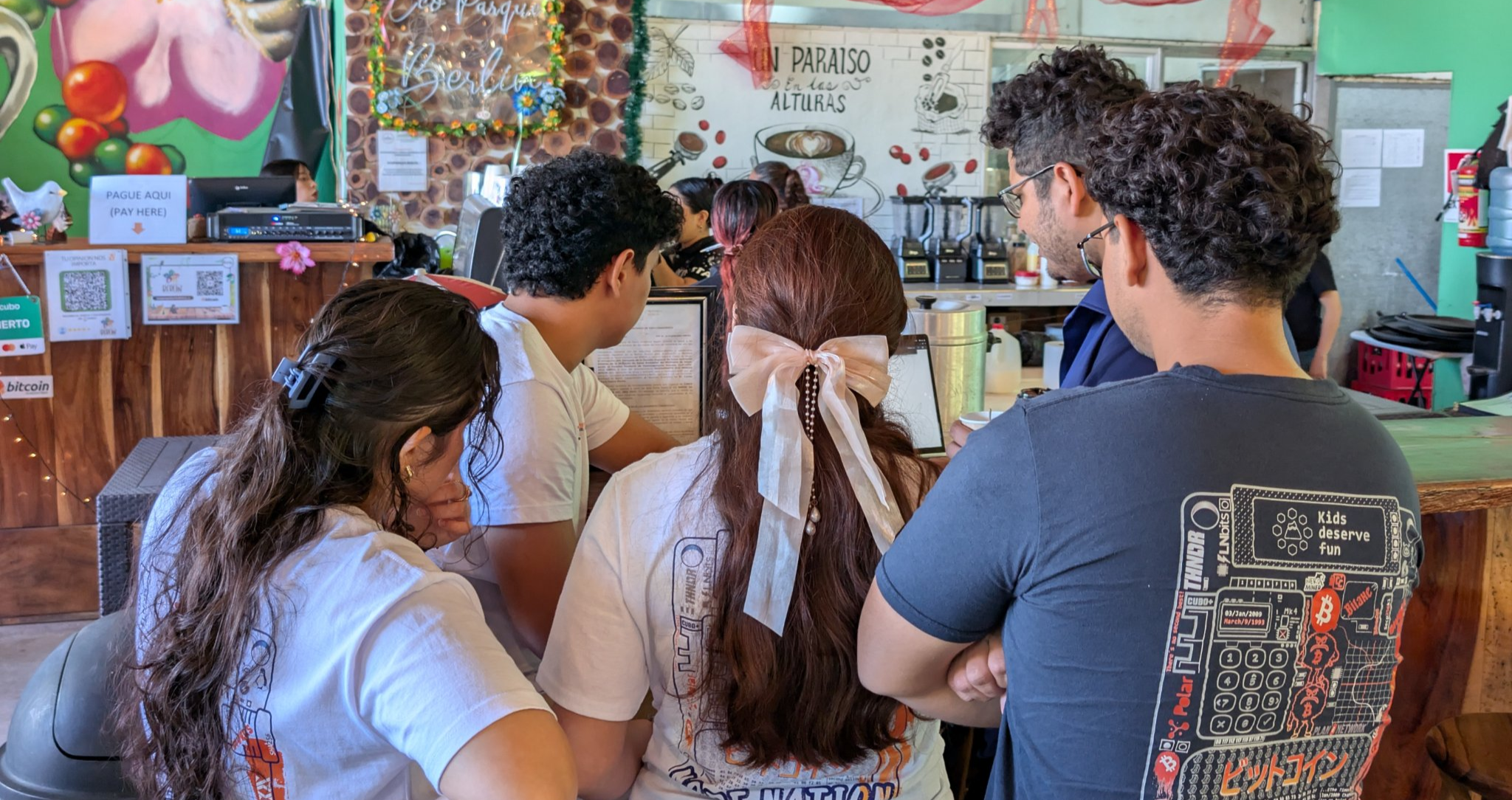
Funding free and open-source software is hard, and grants meant for it often don't come through. What keeps the project alive is a mix of Swiss support, cloud subscriptions, and bespoke work, including Watchmakers United, a luxury watch marketplace in Geneva that accepted the open-source model where a proprietary vendor might have refused. Christophe put the philosophy plainly: because be-BOP is free and self-hostable, the project can outlive the company that built it.
The Blink integration is one example. If you run a be-BOP store and want a Lightning option without hosting your own node, it's there now. And if you see a gap in a tool you use, open source means you don't need anyone's permission to close it. The Blink API docs are a good place to start.
be-BOP is also pushing past the web. In a recent demo, Christophe wired an esp32 microcontroller and a thermal printer to a be-BOP store. You pay by card, PayPal, or GNU Taler, a receipt comes out with a QR code, you scan it with any Lightning wallet, and the sats arrive, drawn from be-BOP's own phoenixd. He describes it as turning be-BOP into an ATM that pays out in sats, with cash at the counter coming next. It's a few months from being usable by anyone, and he's floated the same setup triggering a dispenser or a smart lock. As he put it, you pay on be-BOP and it does things in real life.
If you want to try it before committing to anything, be-BOP runs a free sandbox you can spin up without an account or a card, and the documentation covers both their cloud and self-hosting.
They were also direct about what they need. Adoption first: if you have something to sell, use it. And investors, but a particular kind. In Lionel's words:
"We're looking for investors who share our values on free open source software and privacy. It's an investment in an idea, in a concrete project that makes that idea real. We're not the American startup model, milking users who are locked into the solution."
Any community or company working on Bitcoin adoption that wants to build something specific with them can get in touch.
Does be-BOP support Blink as a payment processor?
Yes. As of PR #2693, be-BOP merchants can add Blink alongside phoenixd, BTCPay Server, Swiss Bitcoin Pay, or their own node.
Which Blink account types work with be-BOP?
Custodial with an API key, custodial with just a Lightning address, and non-custodial (Spark). be-BOP detects the type automatically from the credentials entered.
Can I send Bitcoin out of be-BOP through the integration, or only receive?
Receive-only. It's built for accepting Lightning payments into a Blink account, not sending from be-BOP.
Do I need to run a Lightning node to use Blink with be-BOP?
No. A Blink Lightning address or API key is enough.
Is be-BOP really free?
Yes. It's free and open source under the GNU AGPL v3. You can self-host it or use be-BOP's cloud; the code is public either way.
Where can I see the code?
PR #2693, in the be-BOP-io-SA/be-BOP repository.
Start receiving and sending bitcoin now


